

How to Write About Research in College Application or Common App?


If you are a high school student or a parent of a high school student and have already thought about how you can highlight your achievements in the form of a research paper on your college application, this article is for you.
Indeed, conducting research and possibly publishing it in scientific journals is a remarkable achievement for a high school student. Therefore, it is a good idea to mention it to the admissions officers to make you stand out from the crowd. And in fact, there are a lot of places where you can indicate this. Read below where exactly.
Does Research Look Good On College Applications?
Yes, of course. After all, let's be honest, this is often the reason why high school students conduct research (to impress the admission committee with their achievements).
But before we begin, it is worth noting that a significant research experience at highly selective colleges or universities can make a difference, but it won't speak for itself. You will have to help the admissions officer understand how it is part of your story and how it adds an edge to your overall application.
Make an impactful first impression by sharing not only your research findings but your transformative journey. Share how this journey has helped you refine your research skills, interests, and values.
Elaborate on how this research experience added to your growth and shaped up your personality. Talking about positive research contributions, such as advanced problem-solving ability, can help your application rank in the Common Application activities and honors section as well.
Where to Indicate Research on your College Application or Common App
One of the most widely used ways to submit a college application is through the Common App (Common Application) online. The Common App is a special online platform that lets students apply to up to 20 of its more than 1,100 member colleges with one application.
So let's start with a description of how the sections of activities and honors in Common App can help you share information about your research with the chosen colleges.
Sections of the Common App
Mention your Research in Activities and Experiences
Colleges love to see how productive you have been in spending your time, in addition to formal clubs. Don't worry if you feel you don't have any awards or honors. Your research can cover that.
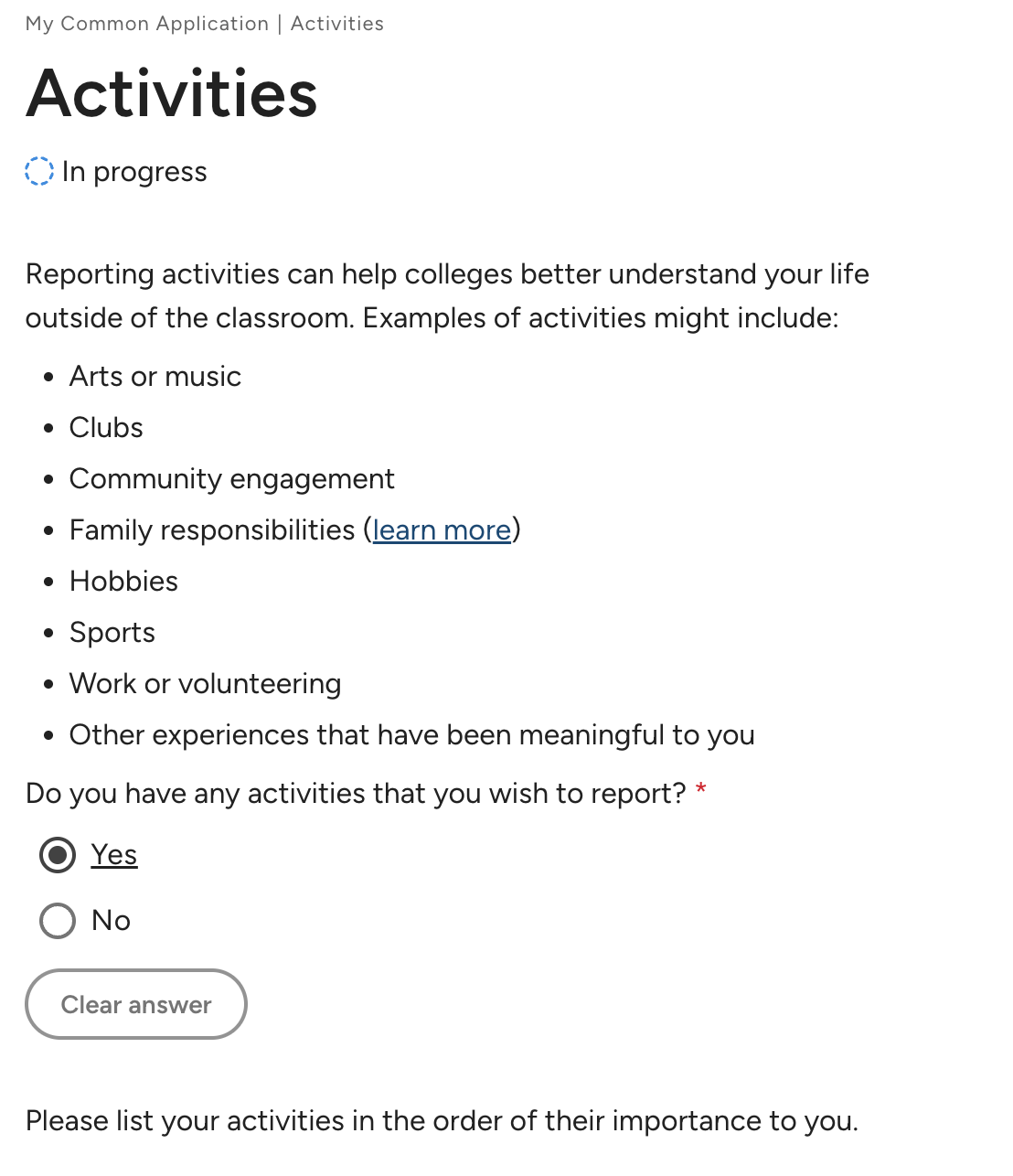
Make conscious attempts to elaborate on your motivation behind selecting your research project. List them in order of importance. Make sure your research makes it to the top three on the list. It would reflect positively on your unique experience and speak about your passion and intellectual curiosity.
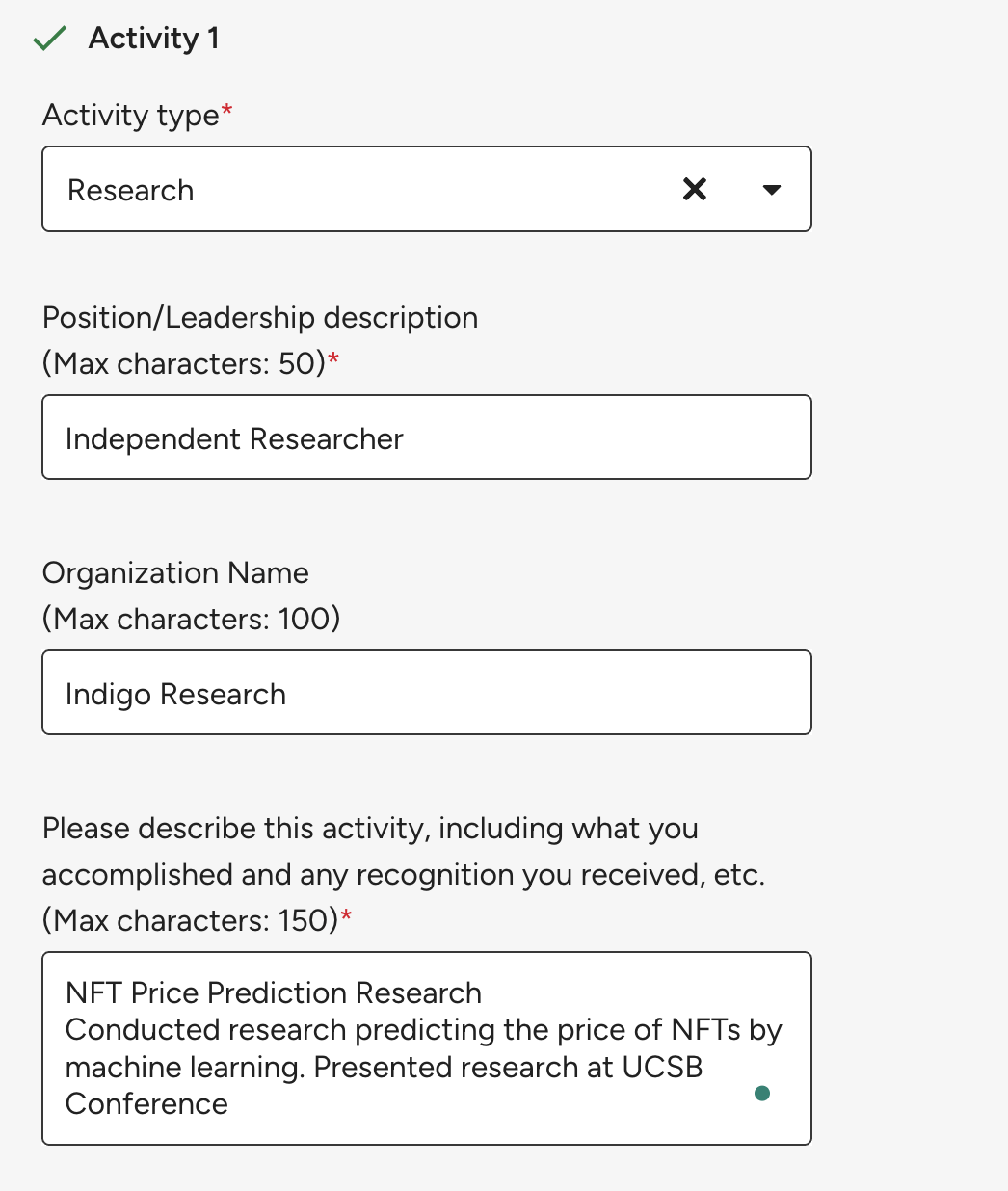
Briefly describe your experience, but make sure you include important details such as how many people worked with you in the team, how many people peer-reviewed your paper, and the name of your professor.
The Common App Activities and Experiences section allows up to 10 entries. Each entry has 50 characters for the position or leadership title, 100 characters for the organization name, and 150 characters for the description. The details about a research project, such as team size, peer reviewers, and the mentor’s name, must fit within those limits.
Example: Australian Educational Research, U. of Newcastle (Researched contemp. education issues w/ Prof. Gore; Halogen Foundation International Comp Winner.)
Add your Research in the Honors Section
There is also a section for honors and awards Common App. If your research did very well, you have recognition up your sleeve, such as the best research paper or being chosen to be published in a journal, then this is the place to add them.
Completing the Honors section in the Common App is not as easy as it seems. Take a quick look at how to fill the Common App Honors Section to get an expert opinion.
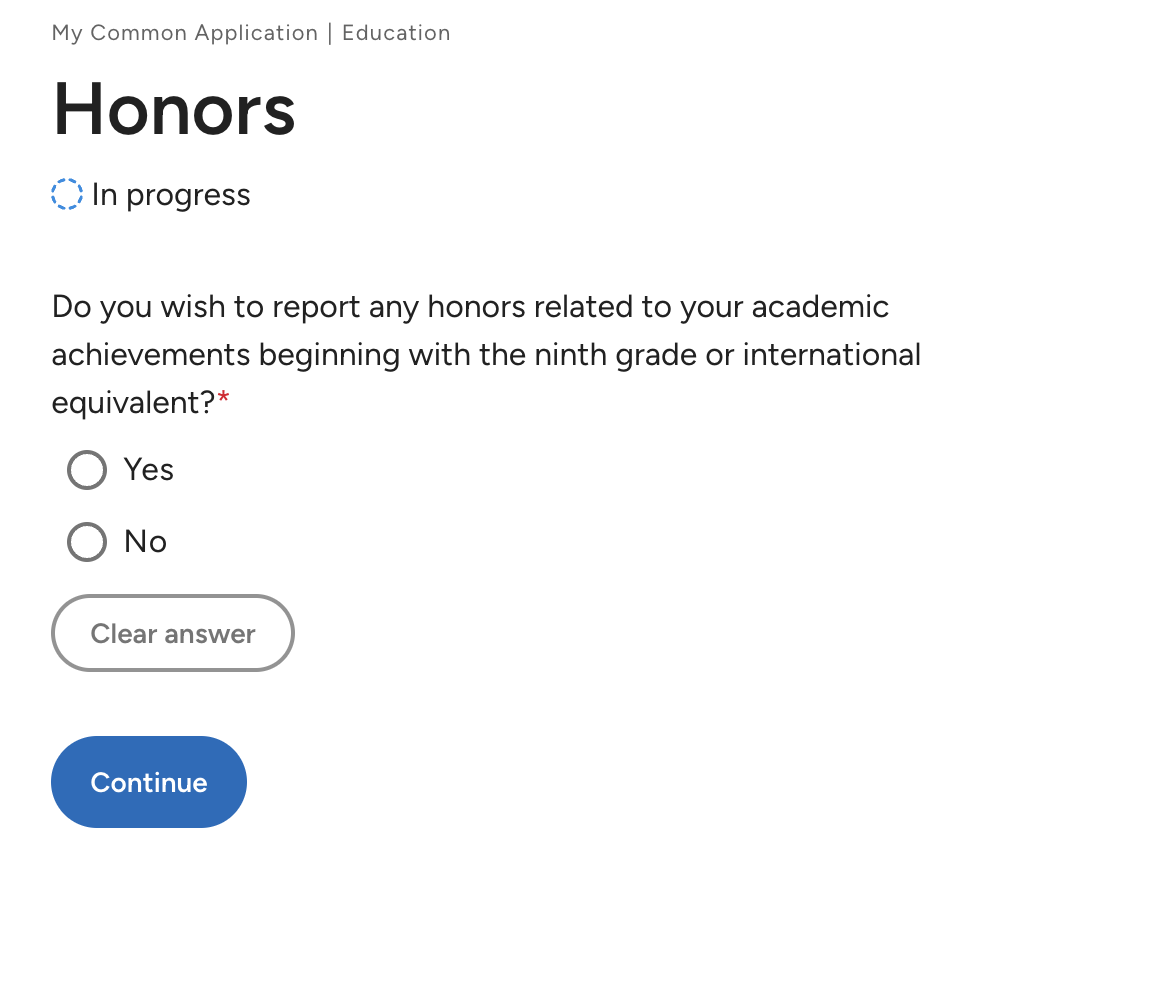
Use the 100-character limit wisely to describe your award. It’s always good to add some context about the award by writing a small description.
Have a look at this Common App Walkthrough that would steer you in the right direction with respect to functionality. It's better to streamline your profiles according to the Common App format.
Other ways you can indicate your Research besides the Common App functionality
Show your Research through Supplemental Material
Supplemental material is not mandatory, but it provides information that can be added to your college application. If you have completed a final report, created a presentation, or done a research project that speaks of who you are and reflects your passion, add it here.
If you opt to submit supplemental materials (although not all universities take these), such as a research paper, it needs to be a good one. Saying you did a good research paper and showing how good you were are two different things. Make sure your paper is thoroughly proofread and your research advisor backs up your claim.
How Yale Takes a Research Paper and a Mentor Letter
Yale University accepts science and engineering research as a supplement to the Common App. Yale states that most successful applicants submit only the required application materials, and it may evaluate supplements for applicants whose required materials already show they are strong candidates. Other colleges set their own supplement rules, so students should check each college’s admissions page before submitting a paper.
Students tell Yale that they plan to submit a supplement by answering Yes to the supplement question when they apply. After submitting the application, students activate the Yale Admissions Status Portal with the personalized link and PIN from the confirmation email. Students then complete the STEM Research Supplement Form on that portal.
The STEM Research Supplement Form asks students to describe their research and, if the work was done with others, their specific contributions. Students can attach a research paper, an abstract, or a poster, and Yale says full research papers are generally the most helpful. Students can also use the form to invite a research mentor to submit a letter of recommendation electronically to the admissions office.
Yale’s deadlines for supplementary materials are November 8 for Early Action and January 9 for Regular Decision.
Add Research Experience To Your Resume (If the College Accepts One)
The Common App does not have a resume upload field for every college, and each college decides whether to accept a resume. Some colleges accept a resume in their own application sections, and others do not accept one. Students should check each college’s admissions page before preparing a resume. If a college accepts one, the research experience can be summarized in bullet points, similar to the Activities and Experiences entry.
You can add both qualitative and quantitative bullets. For the qualitative bullets, mention which skills you developed. Which part of the research project did you take the lead in? Don’t forget to add the name of the program or institution, dates, and the mentor's name.
For the quantitative part, write what data you found. Which computer programs did you learn? How many people were working with you, and what did you accomplish?
List your Research in your Personal Statement
This is your chance to narrate your story by quoting scholastic achievement examples. Your research project may have a small role in your statement or be the main event to highlight. Your research story should speak of your passion. Some students include IB extended essays and use their research experience to tell a story about themselves:
- What excites them?
- What drives their passion?
- How do they approach questions?
- How are challenges overcome?
- What changes do they want to bring to the community as a whole?
Talk About your Research in your College Admissions Interviews
No one besides you can talk about your research projects. Show that you are capable of talking about your complex research project to non-specialists, leaving the interviewers in awe. Also, if the interviewer inquires about your interest in this specific university, you can casually bring up how you have worked under one of their professors during the research project or an internship. Further, you can subtly mention you have stumbled upon their department's research reports while doing your research, and you found them fascinating.
Have your Mentors Mention your Research in the Recommendation Letters
Recommendation letters from experts serve as a good impression of the work that you have done in class. Your teacher can be a strong advocate who can speak about your creativity and independence during the research project.
Usually, students have their mentors submit recommendation letters advocating for their skill, passion, knowledge, and yearning to learn. Like a cherry on top, it would be incredible if your mentor is also a faculty member at the university you are applying to.
This way, they can speak about how you will be a great fit in their university environment.
Wrapping Up
As much as a research project is important for a college application to stand out in the Common App activities and honors section, it's not a guaranteed way for your application to be noticed. Also, it does not mean that the student who does not have a college application backed by a research project will not stand out.
Research experience is not just a box you are trying to check on the college application. It's about strengthening your passion, developing new skills, exploring your interests, and sharing something exciting with the community.
If you’re looking to do some research to enhance your college application, our High School Research Programs can give you a good head start. At Indigo Research, you can begin your research any time throughout the year, so plan to publish your research accordingly, which will help you build on skills and knowledge.
FAQs
What are honors in the Common App?
Honors in the Common App include research projects, awards, or recognitions. Listing these would make your application stand out by speaking about your passion. Colleges have an eye for students who bring diverse interests and talents to the institute.
How many honors can you put on the Common App?
You can list five honors. For this, you have to write a brief description (100 characters or less) for each. You can write the name of the honor, the meaning or purpose behind it, and the year you received it.
Where is the honors section on the Common App?
It's in the education section of the Common App. First, it will ask how many honors you want to list since they are limited to five. So, you may want to list the most important ones and represent your academic achievements to the best.
Do colleges verify your extracurriculars?
Colleges can contact a student’s school to confirm information, because every Common App applicant authorizes colleges to confidentially contact current and former schools. Applicants also certify that the information in the application is accurate, and the Common App affirmation states that false information can lead to admission revocation, expulsion, or revocation of course credit, grades, and degree.
Do colleges ask for proof of extracurriculars?
Some colleges ask for proof of extracurriculars. It will be mentioned in the requirements section. If a college is not asking for it, you don’t have to provide proof of extracurriculars. Colleges usually ask for proof of top-level accomplishments. For example, if you win an international piano competition, you can provide a certificate for that.
Research can be a powerful addition to a college application when it shows genuine curiosity, initiative, and what you learned—not just the title of a project.
At Indigo Research, students work one-on-one with expert mentors to conduct original, publication-ready research. Discover how Indigo can help you turn your interests into meaningful research worth showcasing.