
Journalism Research Project Ideas for High School Students


Key Takeaways
Strong journalism research projects start with the right topic and a clear understanding of how reporting turns an idea into a credible, real-world story, while also building foundational skills for future study or careers in journalism and strengthening college applications through demonstrated research and communication experience.
- A journalism research project is structured reporting where students gather information through interviews, documents, observation, and data to produce original news writing rather than summarizing existing sources. This builds newsworthiness criteria judgment and source evaluation skills essential for credible reporting.
- Newsworthiness criteria such as timeliness, proximity, impact, prominence, and conflict help determine which stories are worth pursuing and how they should be framed, shaping project ideas from the beginning.
- The Five W’s and One H (Who, What, When, Where, Why, How) provide a core structure for journalism writing and ensure stories remain complete, clear, and fact-based throughout reporting.
- The student newspaper serves as the main publication outlet for most journalism projects, shaping editing decisions and creating a real audience that increases accountability and quality.
- The academic year project timeline affects scope and format, with shorter terms requiring narrower beats and longer semesters allowing deeper investigative or multimedia reporting.
- A journalism portfolio for college applications is built from completed projects and demonstrates communication skills, research ability, and sustained reporting experience over time.
What Is a Journalism Research Project and Why It Matters in High School
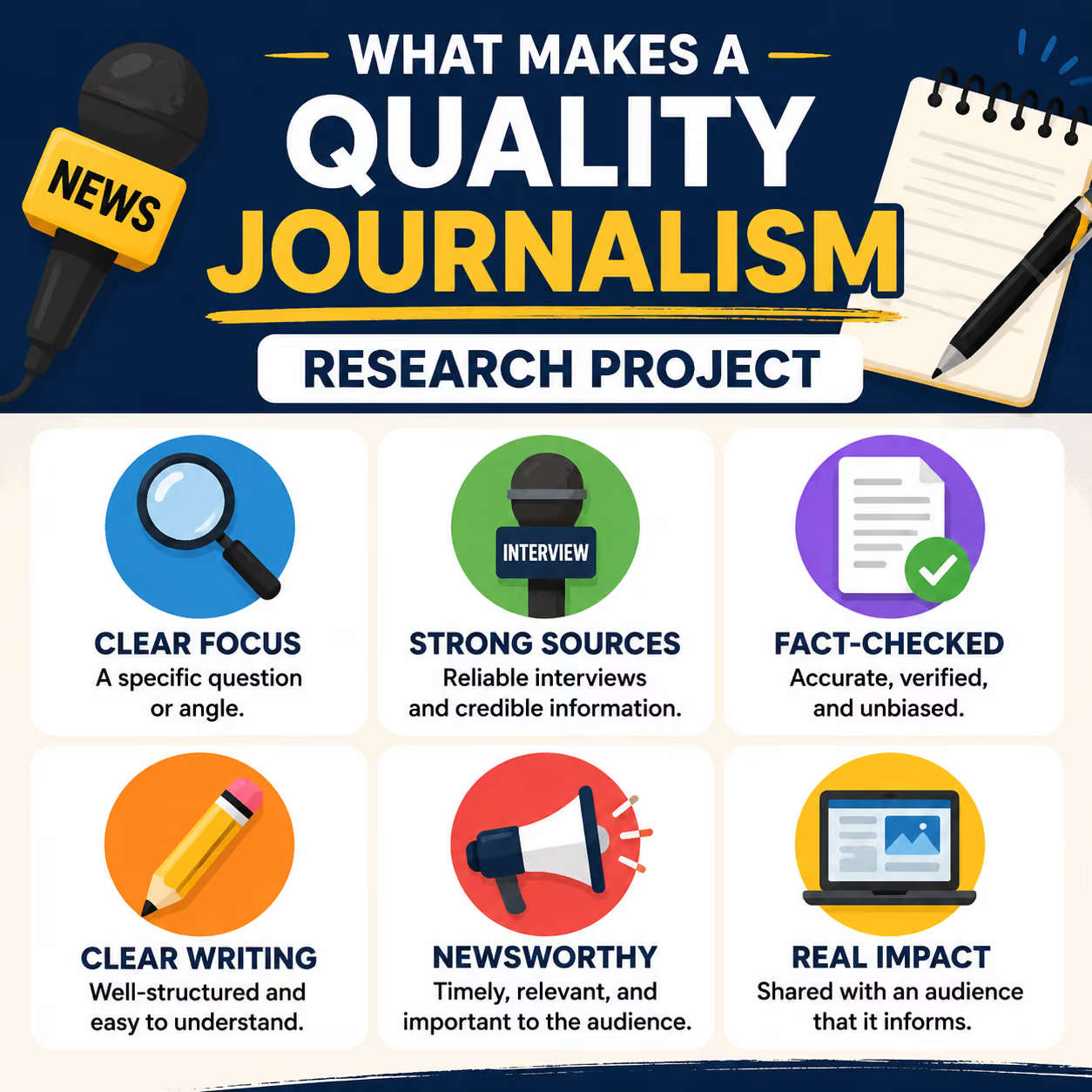
A journalism research project is a structured investigation where students gather information from interviews, documents, data, and direct observation to produce an original, publishable news story. Unlike a traditional research paper, it does not focus on summarizing what others have written. Instead, it emphasizes original reporting, where students uncover new information and communicate it clearly to a real audience. In the process, students build essential journalism skills such as interviewing, fact-checking, source evaluation, and clear news writing, mirroring the work of professional reporters.
Journalism research projects matter in high school because they build real-world skills that extend far beyond the classroom. Students learn how to think critically, verify information, and communicate responsibly, which are valuable abilities in college, future careers, and everyday media consumption. These projects also strengthen college applications and portfolios by demonstrating initiative, research ability, and experience working with real sources and deadlines. The strongest journalism research project ideas for high school students start with a local or school-based issue and are developed through original reporting, including at least one interview and multiple credible sources. By focusing on sourcing, verification, and audience awareness, students create work that is not only academically strong but also meaningful to their community and impactful in the real world.
What a Journalism Project Actually Looks Like
A completed journalism project usually results in:
- A published news article in a student newspaper or website
- A feature story with multiple interviews
- A podcast episode with scripted narration and editing
- A photo essay with captions and sequencing
- A data-based story using surveys or public records
Types of News Writing
A strong journalism project depends on understanding these formats and selecting the right one based on your story goals.
3 main categories:
- Hard news: Factual reporting focused on timely events, structured using the inverted pyramid.
- Feature writing: Narrative-driven storytelling that explores people, experiences, or trends in depth.
- Opinion/editorial writing: Argument-based writing that expresses a viewpoint supported by reasoning and evidence.
Journalism Writing Structure
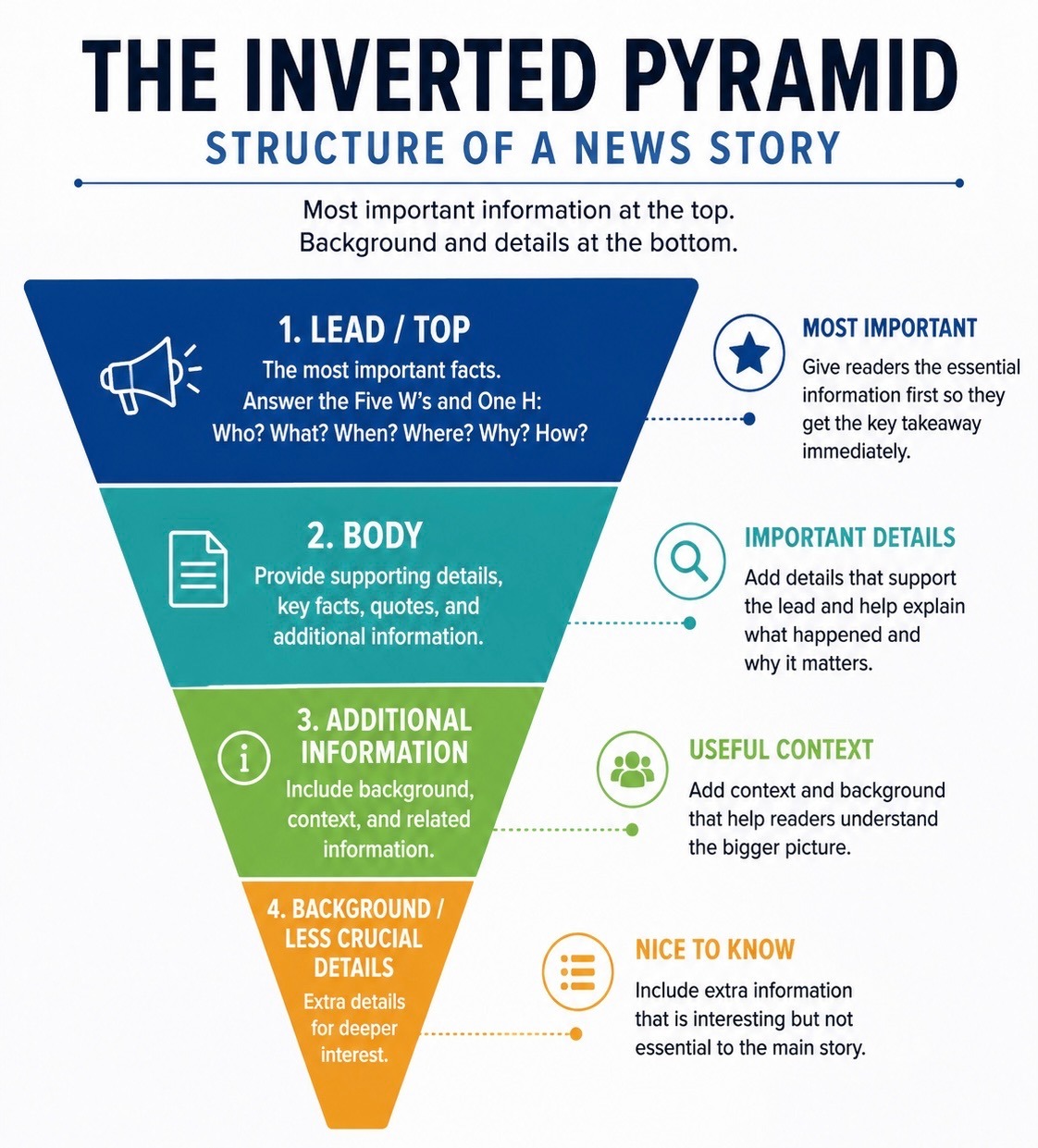
The Inverted Pyramid demonstrates how journalism stories are best structured:
- Most important information
- Key details
- Background context
- Supporting information
This format is widely used in news writing because readers often stop reading after the first few paragraphs, especially in digital media. The Inverted Pyramid concept is especially important because it organizes stories from the most important information to background detail, helping readers quickly understand key facts.
Quick checklist:
- Does the lead include the most important fact?
- Can the reader understand the story in the first paragraph?
- Are quotes placed after core facts are established?
25 Journalism Project Ideas for High School Students
When exploring journalism research project ideas for high school students, it helps to group ideas by difficulty and format rather than treating them as a single list.
5 beginner journalism project ideas:
- Interview students about social media news habits and analyze patterns (profile interview).
- Cover a school event and write a short school newspaper article using AP Style basics.
- Create a photo essay documenting a day in school life (visual storytelling).
- Write a feature on a club, sport, or student organization (feature writing).
- Compare how different students define “newsworthiness” through short surveys.
10 intermediate journalism project ideas:
- Investigate how misinformation spreads on TikTok or Instagram (media literacy focus).
- Write a community reporting piece on a local issue affecting students.
- Produce a podcast episode on school mental health resources.
- Analyze gender representation in school media coverage.
- Conduct interviews with teachers about curriculum changes.
- Build a data-based story using school survey results (data journalism).
- Compare opinion vs news coverage of the same event.
- Create a broadcast script for a school news segment.
- Report on school policy changes and student reactions.
- Document a beat reporting series over a semester.
10 advanced journalism project ideas:
- Investigate school budget allocation using public records requests.
- Conduct a multi-source investigative feature story on school policy decisions.
- Produce a documentary-style video report on a local issue.
- Create a multimedia journalism project combining video, audio, and writing.
- Analyze algorithmic influence on student news consumption patterns.
- Conduct a longitudinal study on student mental health reporting trends.
- Compare press freedom limitations in student journalism using case studies.
- Build a data visualization story using public education datasets.
- Interview journalists about ethical challenges in modern reporting.
- Produce a collaborative class publication with editorial roles assigned.
How to Choose the Right Journalism Project Topic
Journalism project ideas should always be filtered through newsworthiness criteria: timeliness, proximity, impact, prominence, and conflict. These criteria determine whether a story is worth reporting. A strong journalism research project typically starts with a local issue or school-based topic. This ensures proximity and access to sources.
Step-by-step topic selection process:
- Start with a local issue or personal curiosity.
- Apply newsworthiness criteria to test relevance.
- Identify at least 2–3 potential interview sources.
- Confirm access to data or documents.
- Choose the most realistic journalism format.
- Validate feasibility within the academic timeline.
Topics like “History of journalism” are less valid journalism projects because they lack original reporting. A stronger topic would be “How students get news from TikTok vs Instagram.”
Choosing strong journalism project ideas in high school depends on applying news judgment rather than personal preference alone. Students are encouraged to ask the question: “Who is affected, and why does this matter now?”
Journalists often rely on newsworthiness criteria, which include:
- Timeliness
- Proximity
- Impact
- Prominence
- Conflict
Topic selection checklist:
- Is the topic relevant to students or the local community?
- Can I realistically interview at least 2 sources?
- Is there observable data or evidence available?
- Does it meet at least 3 newsworthiness criteria?
Strong vs weak topic examples:
- Weak: History of journalism
- Strong: How students get news from TikTok vs Instagram
- Weak: Why journalism matters
- Strong: How misinformation spreads in school group chats
The Five W’s and One H in Journalism:
The Five W’s and One H (Who, What, When, Where, Why, How) are the foundation of journalism writing and help ensure every story is complete, clear, and fact-based. In journalism research projects, they guide reporting, interviews, and story structure so that no key information is missed.
- Who: Who is involved or affected?
- What: What is happening or being reported?
- When: When did it happen or is it happening?
- Where: Where did it take place?
- Why: Why is it important or happening?
- How: How did it happen or how does it work?
Core Skills Every Student Needs Before Starting a Journalism Project
Strong journalism research project ideas for high school students only work if students understand the core reporting skills behind them. Students improve fastest when they pair each skill with a small practice task, such as writing a 3-sentence lead or conducting a mock interview.
Quick practice exercises:
- Write a 2-sentence news lead
- Conduct a short mock interview
- Rewrite a paragraph in AP Style
Investigative Reporting Projects Focused on School or Community
Investigative reporting is one of the most advanced forms of student journalism. It requires deeper sourcing, structured evidence, and careful ethical consideration.
Investigative workflow:
- Identify a school or community issue
- Research background context
- Identify 2–3 independent sources
- Collect documents or data
- Conduct interviews
- Verify across sources
- Write using inverted pyramid structure
These projects often rely on:
- Interviews
- School documents
- Survey data
FOIA and public records:
Freedom of Information Act (FOIA) requests allow students to access public documents such as budgets, meeting minutes, and policy records. These tools are especially useful for data-driven investigative journalism.
Multimedia Journalism Projects: Podcasts, Videos, Photo Essays
Modern journalism is not limited to written articles. Multimedia formats expand storytelling possibilities. Organizations like PBS NewsHour Student Reporting Labs provide structured pathways for student video journalism. In many college portfolios, multimedia work stands out because it demonstrates cross-platform communication skills.
Podcast projects:
Podcasts require research, scripting, interviewing, and audio editing to tell a story through sound.
- Research topic and define angle
- Write script or outline
- Conduct and record interviews
- Edit and publish final audio
Video reporting:
Video reports combine visual storytelling with structured journalism and require planning, filming, and editing.
- Create storyboard or shot plan
- Film interviews and supporting footage
- Edit video and structure narrative flow
- Add captions, narration, or graphics
Photo essays:
Photo essays use images and captions to build meaning and tell a story visually without relying heavily on text.
- Capture relevant and compelling images
- Select strongest visuals
- Write informative captions
- Arrange images into a narrative sequence
How Journalism Projects Help with College Applications
Journalism projects strengthen college applications by demonstrating initiative, communication skills, analytical thinking, and ethical awareness. They are especially valuable for students applying to programs in communications, political science, media studies, and related fields, where strong writing and research experience help applicants stand out. A well-developed journalism portfolio shows sustained effort over time and provides admissions teams with evidence of real, applied skill development.
Portfolio benefits:
- Published writing samples
- Evidence of original research and reporting
- Strong communication and storytelling ability
- Initiative and independent project development
- Ethical awareness in sourcing and reporting
Timeline insight:
The strongest portfolios are built by the end of junior year, not during the final months of senior year. This allows time for revision, publication, reflection, and submission.
Legal and Ethical Rules Every High School Journalist Must Know
Journalism is guided by ethical standards that shape credibility. Students should get familiar with source protection, copyright rules, and the boundaries of school control under student press law frameworks.
First amendment and student journalism:
Student journalism is shaped by Hazelwood School District v. Kuhlmeier (1988), which allows schools to regulate student publications under certain conditions. Understanding this early helps students make informed decisions about what they can publish and how editorial oversight works in school settings.
Organizations like the Student Press Law Center provide helpful guidance on these issues.
Key principles in journalism focus on accuracy, fairness, and trust, ensuring reporting is responsible and credible.
Core ethics principles:
- Accuracy over speed: Prioritizing verified facts before publishing
- Fair and balanced representation: Reporting multiple perspectives without bias
- Transparent sourcing: Clearly identifying where information comes from
- Avoidance of plagiarism: Using only original work or properly credited sources
Common questions on journalism ethics:
- Can schools censor student journalism?
- What counts as fair use of images?
- When should sources remain anonymous?
- How do journalists verify that information is accurate before publishing?
- What should be done if a source provides conflicting information?
- When is it appropriate to publish sensitive or potentially harmful information?
- How do journalists avoid bias in reporting?
- What are the consequences of plagiarism in journalism?
- How should corrections or errors be handled after publication?
- What ethical responsibilities do journalists have when interviewing minors or vulnerable sources?
The 5 Core Values of Journalism from the Ethical Journalism Network:
Best Organizations and Programs That Support High School Journalism
High school journalism becomes more meaningful when students connect classroom assignments with real-world reporting experiences. Several respected programs and organizations provide training, mentorship, and publication opportunities that help students strengthen their writing, reporting, and media literacy skills. These resources also give students the chance to practice journalism in professional settings and begin building a strong, authentic portfolio of work.
Valuable organizations:
- Journalism Education Association (JEA): training and student journalism standards
- News Literacy Project: media literacy and fact-checking training
- Columbia Scholastic Press Association (CSPA): awards and publication recognition
- Missouri School of Journalism High School Project: immersive journalism training for high school students
- NYU Summer Journalism Program: college-level reporting and writing summer experience
- Camp Cronkite (Arizona State University Walter Cronkite School): hands-on broadcast and multimedia journalism camp
- Knight Center for Journalism (MSU): journalism training and media education programs
- NewseuMED: media education and student journalism training initiative
- The New York Times Learning Network: classroom resources and journalism activities
- ProPublica: investigative research examples
FAQ
What are the best journalism research project ideas for beginners?
Beginner-friendly ideas include school event coverage, student interviews, and simple feature stories.
Do journalism projects need interviews?
Yes, most strong journalism projects include at least one primary source interview.
What makes a journalism project different from an essay?
A journalism project includes original reporting, sourcing, and publication intent, while essays summarize existing knowledge.
How long should a high school journalism project take?
Most projects take 3–8 weeks depending on depth and format.
Can journalism projects help with college applications?
Yes, they are often used as portfolio evidence and demonstrate strong communication and research skills.
The strongest journalism research project ideas for high school students are not necessarily the most complex, but the most focused. A clear question, real sources, and strong storytelling often matter far more than trying to pick the most impressive topic.
Indigo Research can help you take your journalism project from concept to publication, turning your work into something real that you can share with confidence. Start today by choosing a topic that can connect you to real communities, real people, and real issues worth reporting!




.avif)