How to Write a College Application Essay 2025/2026


The college application essay — specifically the 650-word Common App personal statement — is your only chance to speak directly to admissions officers in your own voice. Unlike grades, test scores, or activities, it cannot be summarized in a number. In 2026, when AI-generated writing is everywhere, an essay that genuinely sounds like you has become a competitive advantage, not just a formality.
Key Takeaways
- The college application essay and the personal statement are the same thing. It is one essay, 250–650 words, submitted through the Common App and sent to every school on your list.
- The 7 Common App prompts are unchanged for 2026-2027. The Common Application confirmed this on February 27, 2026. The most popular prompt last cycle was "Topic of Your Choice" (28% of applicants).
- Admissions officers are reading for two things: "Can this student write?" and "Who is this person?" Your essay should answer both in under 650 words.
- Authentic voice beats polished writing. Specific, lived details — the kind only you could write — are what distinguish a strong essay from a generic one in 2026.
- AI can help you brainstorm. Using AI to draft or rewrite your essay is a different matter. Indigo Research does not recommend it, and admissions officers at selective schools are trained to recognize the patterns.
- Start in the summer before senior year. The Common App opens on August 1, 2026. Students who begin brainstorming in June or July have time for multiple drafts before early decision deadlines.
What Is a College Application Essay (and What It Is Not)
The term "college application essay" covers two different types of writing, and confusing them is one of the most common mistakes students make at the start of the process.
Personal Statement
The personal statement is the main college application essay. For students applying through the Common Application — a platform accepted by more than 1,000 colleges and universities — the personal statement is a single essay of 250 to 650 words. You choose one of seven prompts, write one essay, and that same essay is sent to every Common App school on your list.
When people search "how to write a college application essay," they almost always mean the personal statement. This guide focuses on the personal statement.
Supplemental Essays
Supplemental essays are additional short-response essays required by individual schools on top of the personal statement. They are school-specific, typically 150 to 300 words each, and ask questions like "Why do you want to attend this school?" or "Describe a challenge you have faced". Most selective universities require between one and five supplemental essays. Writing supplemental essays is a separate process and is not covered in this guide.
Application Platforms and Word Limits
Different application platforms have different word limits. Here is a quick reference:
One practical note: the Common App is not the same as a specific school's application. The Common App is the platform. The schools that accept it are its member institutions. If a school requires supplemental essays, those appear inside the school's section of the Common App portal, separate from your personal statement.
All 7 Common App Essay Prompts for 2026-2027 Explained
On February 27, 2026, the Common Application officially confirmed that the essay prompts for the 2026-2027 admissions cycle are unchanged from the previous year. There are seven prompts. You choose one and write a personal statement of 250 to 650 words.
Below are all seven prompts with usage data from the 2025-2026 cycle and brief guidance on each.
- Background, Identity, Interest, or Talent — 18% of applicants chose this in 2025-2026
"Some students have a background, identity, interest, or talent that is so meaningful they believe their application would be incomplete without it. If this sounds like you, then please share your story."
This prompt works when there is something so central to who you are that leaving it out would leave the admissions committee with an incomplete picture. The risk is being generic. If you choose this prompt, make sure your essay goes beyond naming the identity or talent — show how it has shaped how you think, decide, or act.
- Challenge, Setback, or Failure — 23% of applicants (second most popular)
"The lessons we take from obstacles we encounter can be fundamental to later success. Recount a time when you faced a challenge, setback, or failure. How did it affect you, and what did you learn from the experience?"
This is the most misused prompt because students often spend 80% of the word count describing the problem and 20% on the growth. Reverse that ratio. What the admissions committee wants to understand is how you responded and what changed in you — not the severity of the obstacle.
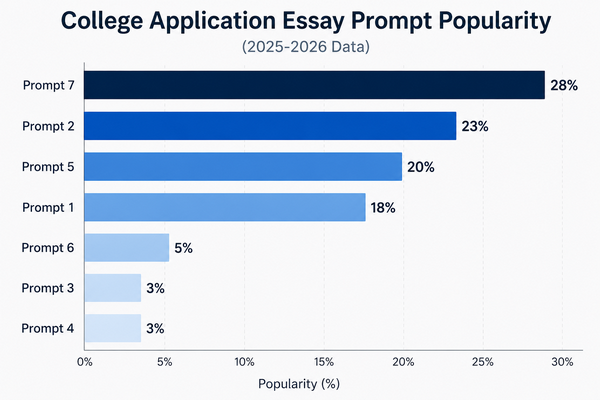
- Questioned or Challenged a Belief — 3% of applicants
"Reflect on a time when you questioned or challenged a belief or idea. What prompted your thinking? What was the outcome?"
Low usage does not mean a weak prompt — it means most students avoid it because it requires intellectual courage. The best essays on this prompt show genuine uncertainty and real change, not a confident takedown of an easy target. The belief does not need to be political or grand.
- Gratitude — 3% of applicants (newest prompt, added in the 2024-2025 cycle)
"Reflect on something that someone has done for you that has made you happy or thankful in a surprising way. How has this gratitude affected or motivated you?"
Prompt 4 was added for the first time in the 2024-2025 cycle and retained unchanged for 2026-2027. The common mistake is spending most of the essay describing the other person. This prompt is about you — specifically, about how someone else's action changed something in how you think, behave, or move through the world.
- Personal Growth and New Understanding — 20% of applicants
"Discuss an accomplishment, event, or realization that sparked a period of personal growth and a new understanding of yourself or others."
This prompt is similar to Prompt 2 in structure but broader. The "accomplishment" does not need to be an award or a formal achievement — a quiet realization counts. The key is showing a visible before-and-after: who you were before the event and who you were after it.
- Intellectual Passion — 5% of applicants
"Describe a topic, idea, or concept you find so engaging that it makes you lose all track of time. Why does it captivate you? What or who do you turn to when you want to learn more?"
This prompt rewards students with a genuine intellectual interest they can write about with specificity and depth. The pitfall is surface-level enthusiasm: listing a topic you find interesting is not the same as demonstrating how you think about it. If you choose this prompt, show the reader what goes on in your mind when you engage with the subject, not just that you enjoy it.
- Topic of Your Choice — 28% of applicants (most popular)
"Share an essay on any topic of your choice. It can be one you've already written, one that responds to a different prompt, or one of your own design."
Prompt 7 is the most popular not because students are avoiding effort, but because the best stories are often too specific or too unusual to fit neatly into Prompts 1 through 6. This prompt exists for those stories. The only requirement is that the essay reveals something meaningful about who you are.
How to Choose the Right Common App Prompt for Your Story
The most common mistake in prompt selection is starting with the prompt. Students read the seven options, pick the one that seems safest or most impressive, and then try to shape their story to fit it. This is backwards.
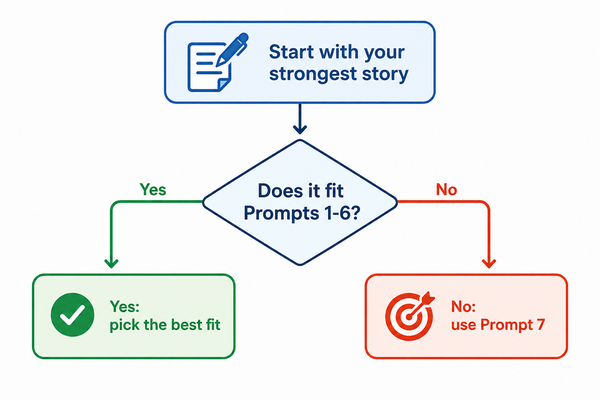
The prompt you choose matters far less than the story you tell. Start with the story. Then find the prompt that gives it the most room.
A 3-Step Process for Choosing Your Prompt
- Find your strongest story first. Ask yourself: what experience, moment, or realization from your life would you most want an admissions officer to know about you that is not already reflected in your grades, test scores, or activities list? Write down two or three candidates.
- Hold each story against the seven prompts. Most strong stories fit more than one prompt. A story about overcoming a learning difference could work as Prompt 1 (identity), Prompt 2 (challenge), or Prompt 5 (growth). Pick the frame that lets the story breathe most naturally — not the prompt that sounds most academic or most impressive.
- If nothing fits Prompts 1 through 6, use Prompt 7. That is what it is there for. The most popular prompt in the 2025-2026 cycle (28% of applicants) is Prompt 7 — "Topic of Your Choice" — precisely because authentic stories rarely arrive pre-formatted into the shape of a named prompt.
What Not to Base Your Choice On
- Popularity. Choosing Prompt 2 because 23% of students chose it last year is not a strategy.
- Perceived safety. The "challenge" prompt is not safer than the "gratitude" prompt. A weak story told through any prompt will read as weak.
- What you think admissions officers want to read. They want to read a story that sounds like you. That is the only reliable criterion.
How to Brainstorm Your College Application Essay Topic
Brainstorming is the step most students skip or rush, and it is the reason most first drafts fail. A strong personal statement comes from a story only you could tell — and finding that story requires actual excavation, not just sitting down and writing whatever comes to mind first.
The Common App opens on August 1, 2026. Students who begin brainstorming in June or July have time to generate multiple candidates, draft more than one, and choose the strongest. Students who start in October are editing under deadline pressure with the first idea they had.
Three Brainstorming Methods That Work
1. The Values Exercise
Write down five to seven values that feel central to who you are — things like curiosity, loyalty, fairness, creativity, or discipline. For each value, write down one specific moment from your life when that value was tested, demonstrated, or changed. The goal is not to find the most impressive moment. The goal is to find a moment that is genuinely yours and that reveals something about how you think.
2. The Essence Objects Exercise
Look around the space where you spend most of your time. Pick three to five objects that represent something meaningful about who you are. Write a paragraph about each one — not what the object is, but what it says about you and why you keep it. This exercise often surfaces essay topics that students would never have thought to write about directly: a tool, a book, a piece of clothing, a piece of equipment. The ordinary, specific detail is usually more powerful than the headline achievement.
3. The 21 Details Exercise
Write down 21 specific details from your life. Not categories ("I like music") but concrete, sensory specifics ("the way the bass line in the third song on that album made me rethink what I thought silence felt like"). Do not edit. Do not judge. Write 21. Then read them back and look for the two or three that surprise even you. Those are often the seeds of the strongest essays.
How to Evaluate Your Brainstorming Results
After brainstorming, ask this question about each candidate story: could any other applicant at your school have written this? If the answer is yes, keep looking. The story that only you can tell is the one worth writing.
A meaningful topic does not need to be dramatic. One of the most memorable essays a Hopkins admissions officer has cited publicly was about a student's passion for making the perfect hot sandwich. What made it work was not the subject — it was the specificity and authenticity with which the student wrote about it.
How to Structure and Write a College Application Essay
The college personal statement is not a five-paragraph argumentative essay. It is a narrative — more closely related to a short personal essay or a memoir excerpt than to anything you have written for a class. The structure should emerge from the story, not be imposed on top of it.
Two Structures That Work
Narrative Structure
The narrative structure focuses on a single scene or experience and moves through it in close detail. It works best when there is one moment that captures everything the essay needs to say. A typical shape: drop the reader into a specific moment (not a thesis statement), develop what happens and what you are thinking, reach a turning point or realization, and end with a reflection that opens outward — connecting the moment to who you are now.
Montage Structure
The montage structure connects multiple smaller moments through a single unifying theme or idea. It works best when your story cannot be reduced to a single experience — when who you are is better shown through a pattern of moments than through one event. The thread that connects the moments must be explicit and strong; without it, the essay reads as a list, not a story.
How to Open a College Application Essay
The first sentence of a college application essay does one thing: it earns the reader's attention. Admissions officers at selective colleges read between 20 and 50 essays per day during peak season. The opening does not need to be dramatic, but it must be specific.
What works: dropping the reader into a specific moment, asking a genuinely surprising question, or beginning with an observation that only you would make.
What does not work: opening with a famous quote, announcing what the essay is about ("In this essay I will..."), or starting with a broad generalization ("Since the beginning of time, humans have..."). These are signals that the essay will not be specific or personal.
Show, Don't Tell — What This Actually Means
The instruction to "show, don't tell" is given in almost every writing guide, and almost never explained concretely. Here is what it means for a college essay:
Telling gives the reader a label and asks them to accept it on faith. Showing gives the reader evidence and lets them draw their own conclusion.
Telling: "I am a dedicated leader who cares about my team."
Showing: "I stayed after practice to redraw the play on the whiteboard for the two freshmen who were still confused, and we ran it three more times until they could call it themselves."
In the second version, the reader concludes "dedicated leader" without being told. That shift — where the label becomes the reader's conclusion, not the writer's assertion — is the whole technique. Apply it to every quality you want the essay to convey.
A strong college application essay contains four to five distinct values that emerge through the story, not values that are stated directly. If you find yourself writing "I am curious" or "I learned resilience," replace those sentences with a scene that demonstrates the quality instead.
The Personal Growth Arc
Most strong personal statements, regardless of which prompt they answer, follow a personal growth arc: a visible before-and-after in how the student thinks, behaves, or sees the world. This does not mean every essay needs to be about overcoming hardship. The change can be subtle — a shift in perspective, a question that opened up where there was certainty before. What the essay must show is that the writer has reflected on experience and arrived somewhere new.
Note for International Students
Students whose first language is not English sometimes over-polish their writing in an attempt to sound formal or academically impressive. This is understandable, but it works against you. Elevated, formal vocabulary in a personal statement reads as inauthentic — and in 2026, it can also trigger the same patterns that admissions readers associate with AI-generated writing. Natural voice and direct language beat sophisticated vocabulary every time. Write the way you think, not the way you imagine a formal document should sound.
The Writing and Revision Process
- Step 1 — Brainstorm: Use the methods in Section 5 to generate candidates. Do not write a draft until you have at least two or three story options.
- Step 2 — Outline: Decide on structure (narrative or montage). Write a sentence for each paragraph describing what it does, not what it says.
- Step 3 — First draft: Write without editing. Get the story on the page. Most first drafts are too long and too general — that is normal.
- Step 4 — Revise for story and voice: Read for "show vs. tell." Cut anything that repeats what is already in your activities list. Replace generalizations with specific moments.
- Step 5 — Revise for structure: Check the opening (does it earn attention immediately?), the ending (does it open outward, not just summarize?), and the through-line (is there a clear arc or theme?).
- Step 6 — Get feedback: Ask someone who knows you to read it. The test is simple: does it sound like you? If they say "this doesn't sound like how you talk," it needs another draft.
- Step 7 — Final check: Verify word count inside the Common App platform itself before submitting, not in your word processor. The counts can differ.
College Application Essay Format Requirements
The Common App personal statement has specific technical requirements. Most of them are enforced automatically by the platform, which means errors show up as rejections, not warnings.
Word Limits
- Minimum: 250 words. The Common App will not allow submission below this threshold.
- Maximum: 650 words. The platform cuts your essay without warning if you exceed this. The word count shown in your word processor may differ slightly from the Common App's counter — always verify inside the platform before submitting.
- Recommended target: 500 to 650 words. A well-developed essay with a complete narrative arc typically needs at least 500 words. Shorter essays are not penalized, but essays under 400 words often feel underdeveloped.
Formatting Rules
- There is no required font or font size for the Common App essay. The platform's text input field applies its own formatting when you paste.
- Formatting such as bold, italics, and underline is generally not preserved when you paste into the Common App text box. Do not rely on formatting to carry meaning.
- Use plain text paste: When copying from Google Docs or Microsoft Word, use Ctrl+Shift+V (or Command+Shift+V on Mac) to paste as plain text. This prevents hidden formatting characters from affecting your word count or display.
- Write and finalize your essay in Google Docs or Microsoft Word before pasting into the application. Do not draft directly in the portal — it can be glitchy and does not autosave reliably.
Essay Title
A title is generally unnecessary for a Common App personal statement. If you add a title inside the essay text box, it counts toward your 650-word limit. Most admissions readers do not expect a title and do not look for one. Unless a specific prompt or school explicitly requests a title, skip it.
One Practical Caution
The Common App Additional Information section was reduced from 650 words to 300 words in the 2025-2026 cycle. If you were planning to continue or extend your personal statement in that field, it is no longer a practical option at any significant length. The Additional Information section is designed for context (explaining a grade, a gap, an unusual circumstance), not for overflow essay content.
Common Mistakes That Hurt College Application Essays
Admissions officers at selective colleges read between 20 and 50 essays per day during peak season. The essays that disappear into the pile share predictable patterns. Here are the most common mistakes and how to avoid them.
1. Restating the Activities Section
The personal statement is the one part of the application not already covered by your grades, test scores, or activities list. If your essay describes an award you won, a leadership role you held, or an academic achievement already listed elsewhere, you have spent 650 words telling the admissions committee something they already know. The essay should add a dimension they cannot find anywhere else in your application — how you think, what you value, what happened inside you.
2. Writing Mostly About Another Person
Essays about an inspiring coach, grandparent, teacher, or mentor are common and almost always fall flat for the same reason: the reader learns a great deal about someone else and very little about the applicant. A reliable test: if more than one-third of your word count is describing another person's qualities or actions, the essay has drifted off target. The other person can be present — but only as the context for your reaction, your change, and your growth.
3. Choosing a Generic or Overused Topic
The sports victory, the mission trip abroad, the COVID-19 pandemic, the immigrant grandparent, the moment you discovered your passion — these are not forbidden topics, but they are starting points that require exceptional execution because thousands of other applicants are writing the same narrative. If you choose a common topic, the story you tell within it must be so specific and so genuinely yours that the surface similarity to other essays becomes irrelevant.
4. Submitting AI-Generated Prose
Using AI to draft or rewrite your college application essay undermines the essay's purpose. Admissions officers at selective schools are trained to recognize AI-generated writing — not primarily through detection software, but through reader intuition. The patterns are consistent: unnaturally smooth transitions, generic emotional language, polished sentences that contain no specific detail, and a register that does not match the applicant's short-answer responses elsewhere in the application. Indigo Research does not recommend using AI to draft or rewrite any part of your personal statement. There is an additional risk for international students: AI detection tools can return false positives on non-native English writing, flagging careful, deliberate prose as machine-generated even when it is not.
5. Padding to Hit the Word Count — or Stopping Far Short of It
An essay that reaches 650 words by repeating points, adding unnecessary context, or restating the conclusion is weaker than a focused 550-word essay. Edit ruthlessly. Every sentence should do work. At the same time, an essay of 280 words signals to the reader that the student did not have enough to say about the topic — or did not invest enough time in developing it. The recommended range of 500 to 650 words exists for a reason: a complete personal narrative with reflection requires that much space.
6. Opening With a Famous Quote
Opening a personal statement with a quote from a public figure is one of the most reliable signals that the essay will not be personal. It begins by giving the floor to someone else. Start with your voice, your moment, your observation — not borrowed authority.
Can You Use AI to Write Your College Application Essay
This is the most frequently asked question about college essays in 2026, and it deserves a direct answer.
Can you use AI to write your Common App essay?
You should not use AI to draft, rewrite, or generate the narrative of your college application essay. This is Indigo Research's position, and it is shared by the majority of college admissions offices at selective institutions. In a 2025 Kaplan survey, half of admissions officers stated that AI assistance on application essays is unethical. That position has become more consistent, not less, as detection methods have improved heading into 2026.
The more fundamental reason not to use AI to write your essay is that it defeats the purpose of the essay itself. The personal statement exists to show admissions officers who you are. An AI cannot tell them that.
How do admissions officers detect AI-written essays?
Admissions readers at selective colleges identify AI-generated prose primarily through human intuition, not software. The patterns they look for include:
- Voice mismatch: a polished, formal personal statement that sounds nothing like the student's short-answer responses or writing samples elsewhere in the application.
- Polished emptiness: flawless grammar and sentence structure combined with vague, generic ideas that contain no specific detail.
- Absence of lived detail: no sensory specifics, no idiosyncratic observations, nothing that only this student could have written.
AI detection software (such as Turnitin's AI indicator) is used by some institutions but is not universal and can produce false positives — particularly for non-native English speakers whose careful, deliberate prose can be flagged incorrectly. This is an additional reason international students should be especially careful about this issue.
What AI tools are permitted?
Using AI to brainstorm topics, generate a list of potential story ideas, or check grammar and spelling is different from using AI to write the essay. The line is substantive content: if an AI tool produces the ideas, the specific phrasing, or the narrative arc of your essay, you are no longer the author of the essay you are submitting.
Indigo Research recommends using AI tools only for brainstorming and grammar checks — and treating any AI-generated phrasing as raw material to be completely rewritten in your own voice before it appears in a draft.
At Indigo Research, students work one-on-one with expert mentors on original research in subjects they care about — the kind of specific, authentic intellectual work that becomes the foundation for essays that stand out.
College Application Essay FAQs
Do the Common App essay prompts change every year?
No, not necessarily. The Common Application typically announces any prompt changes in late winter or early spring for the upcoming cycle. For 2026-2027, the prompts were confirmed unchanged on February 27, 2026. The seven current prompts have been stable in substance since 2022, with the addition of Prompt 4 (Gratitude) in the 2024-2025 cycle.
What is the difference between a personal statement and a supplemental essay?
The personal statement is one essay, 250 to 650 words, submitted through the Common App and sent to every school on your list. It uses one of seven Common App prompts. Supplemental essays are additional short-response essays required by individual schools — they are school-specific, usually shorter (150 to 300 words), and ask focused questions about your interest in that specific institution, a major, or a particular community. You write one personal statement and potentially many supplemental essays.
Should I add a title to my college application essay?
Generally, no. A title is not expected or required for the Common App personal statement. If you add one inside the text box, it counts toward your 650-word limit. Skip the title unless a specific school or prompt explicitly asks for one.
How long should a college application essay be?
The Common App personal statement must be between 250 and 650 words. Most admissions experts recommend targeting 500 to 650 words. An essay of fewer than 400 words often feels underdeveloped; an essay padded to reach 650 words without sufficient substance is weaker than a focused 550-word essay. Let the story determine the length within the allowed range.
Can I use the same personal statement for every school?
Yes. The Common App personal statement is designed to be sent to all Common App member schools simultaneously. You write one essay and it goes to every school on your list. Supplemental essays, by contrast, are school-specific and cannot be reused without significant revision.
What happens if my essay goes over 650 words on the Common App?
The Common App platform will not allow you to submit an essay that exceeds 650 words. If you paste in a longer essay, the platform cuts it at the word limit without warning. Always verify your word count inside the Common App portal before submitting — your word processor and the platform may count slightly differently.
When should I start writing my college application essay?
The summer before senior year — ideally June or July. The Common App opens for the new cycle on August 1. Students who begin brainstorming in early summer have time to generate multiple story candidates, write more than one draft, and revise deliberately before early decision and early action deadlines in October and November.
How many drafts should I write?
Most students write between three and five drafts of a personal statement before it is ready to submit. The first draft gets the story on the page. The second draft fixes structure and removes generic language. The third draft sharpens voice and specificity. Additional drafts address feedback. Do not submit the first draft.
A strong college essay goes beyond listing achievements—it tells your story, reflects your curiosity, and shows what makes you unique. Meaningful academic experiences, like research, can give you authentic stories and insights to draw from.
At Indigo Research, students work one-on-one with expert mentors to pursue original research in subjects they care about. Discover how Indigo Research can help you build experiences that strengthen both your academic profile and college essays.