

Why Stanford University? Facts About Stanford University

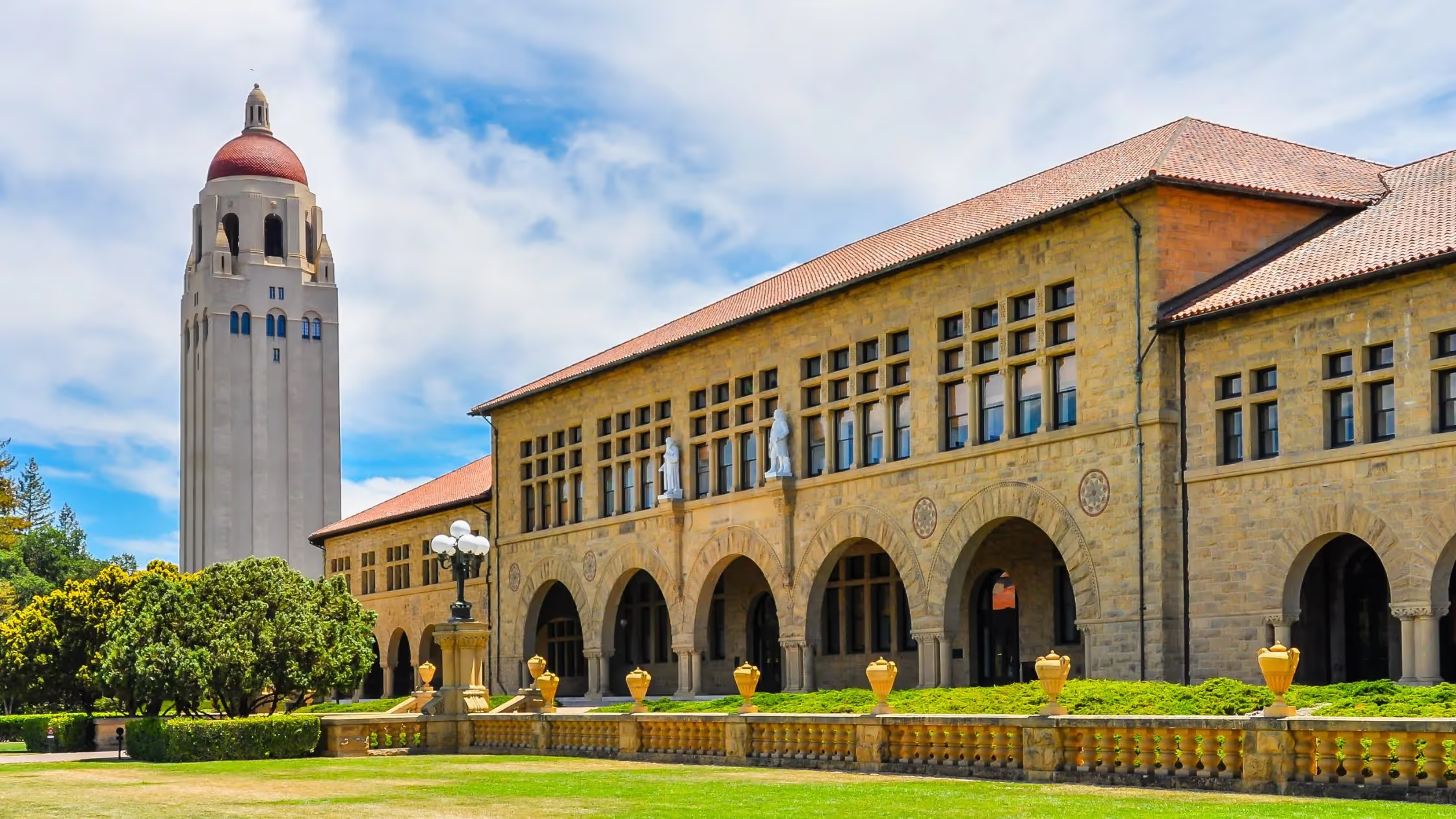
Key Takeaways
- Leland and Jane Stanford founded Stanford University in 1885, and the university opened in 1891 in Stanford, California.
- As of Autumn Quarter 2025, Stanford University enrolls 7,289 undergraduate students and 10,025 graduate students across seven schools.
- Stanford University reports an approximate 5-to-1 student-to-faculty ratio in undergraduate education, and its Fall 2025 community of scholars includes 22 Nobel laureates.
- Stanford University requires first-year applicants to submit ACT or SAT scores, sets no minimum score, and reported a middle 50 percent SAT range of 1520 to 1570 for Class of 2029 students who submitted scores.
- Parents with annual incomes below $150,000 and typical assets pay no tuition at Stanford University, and parents with incomes at or below $100,000 and typical assets pay no tuition, room, or board.
- Stanford University reports more than 7,500 externally funded sponsored research awards and $2.3 billion in sponsored support revenue for the fiscal year ended August 31, 2025.
Interesting Facts About Stanford University
Student Enrollment (as of Autumn Quarter 2025)
- 7,289 undergraduate
- 10,025 graduate
Academic Programs
- 66 undergraduate majors
- 150 graduate programs
Stanford University has seven schools:
- Graduate School of Business
- Stanford Doerr School of Sustainability
- Graduate School of Education
- School of Engineering
- School of Humanities and Sciences
- Stanford Law School
- School of Medicine
Campus
- 8,353 total acres
- 630 buildings covering about 17.9 million square feet
- More than 600 official student organizations
Awards and Honors (Fall 2025)
- 22 Nobel laureates in the Stanford community
- 36 Nobel Prize winners since the university’s founding
- 4 Pulitzer Prize winners
- 7 National Medal of Science recipients
- 34 MacArthur Fellows
- 6 National Humanities Medal recipients
- 1 Presidential Medal of Freedom recipient
Research
- 7,500+ externally funded sponsored awards
- 15 independent laboratories, centers, and institutes
- $2.3 billion in sponsored support revenue (fiscal year ended August 31, 2025)
Budget and Endowment
- $10.3 billion consolidated university budget for 2025-26 (includes SLAC National Accelerator Laboratory)
- $40.8 billion endowment (as of August 31, 2025)
Notable Alumni
- Sergey Brin and Larry Page - Co-founders of Google
- Jerry Yang and David Filo - Co-founders of Yahoo
- Reed Hastings - Co-founder of Netflix
- Jensen Huang - Co-founder of NVIDIA
Why Choose Stanford University?
What makes Stanford unique? Why should you study here? Here are 8 reasons why:
1. Top-Tier Academics
Stanford University offers its academic programs through seven schools, and its Fall 2025 community of scholars includes 22 Nobel laureates and 34 MacArthur Fellows. Stanford University reports an approximate 5-to-1 student-to-faculty ratio in undergraduate education. First-year and second-year students can also join Introductory Seminars, small classes that enroll more than 2,000 students each year.
Stanford University undergraduates complete at least 180 units, including major courses, writing and rhetoric requirements, and one year of a foreign language. Every Stanford University undergraduate also completes the Ways of Thinking / Ways of Doing general education requirements, which total 11 courses across 8 interdisciplinary categories. Stanford University asks first-year applicants for letters of recommendation from two academic teachers. Find out how to ask for teacher recommendations here
2. Vibrant Campus Life
Stanford University guarantees housing to entering first-year undergraduates for four years, and about 98 percent of eligible undergraduates live in campus housing. The undergraduate housing system includes 80 facilities. Stanford Dining, Hospitality & Auxiliaries serves 25,000 meals a day across dining halls, residences, cafes, and markets.
More than 600 official student organizations at Stanford University plan over 1,500 events a year. Students also take part in Stanford traditions such as the Big Game against the University of California, Berkeley, fountain hopping, and the Wacky Walk during Commencement
3. Global Exposure
The Bing Overseas Studies Program at Stanford University offers study away in Australia, Berlin, Cape Town, Florence, Hong Kong, Kyoto, Madrid, New York, Oxford, Paris, and Santiago. Each year, approximately 900 Stanford University students, about 50 percent of the average class year, study away on Stanford programs. Stanford University also runs faculty-led Global Seminars in locations worldwide.
The Stanford University Class of 2029 enrolled 1,866 students from 50 U.S. states and 64 countries outside the United States. About 14 percent of the Class of 2029 attended international high schools.
4. Diverse Extracurriculars
The Office of Student Engagement at Stanford University oversees more than 600 official student organizations, including about 30 religious organizations and more than 100 arts organizations. Other organization types include ethnic and cultural, community service, social awareness, athletic and recreational, and pre-professional groups. The Stanford University athletics program fields 36 varsity sports.
The Haas Center for Public Service at Stanford University supports students through more than 150 community-engaged Cardinal Courses and more than 600 funded, full-time Cardinal Quarter fellowships and internships offered locally, nationally, and globally.
5. Thriving Arts Culture
Stanford University has more than 100 student organizations dedicated to the arts. Bing Concert Hall and Frost Amphitheater stand across Palm Drive from the Anderson Collection at Stanford University and the Cantor Arts Center.
The Cantor Arts Center at Stanford University opened in 1894 as the Leland Stanford Junior Museum. Its collection spans 5,000 years and includes more than 40,000 works of art from around the globe. The Anderson Collection at Stanford University, next door, displays modern and contemporary American art.
6. Cutting-edge Research Opportunities
Stanford University reports more than 7,500 externally funded sponsored awards and $2.3 billion in sponsored support revenue for the fiscal year ended August 31, 2025, including SLAC National Accelerator Laboratory. The federal government sponsors over 70 percent of these awards. Stanford University also has 15 independent laboratories, centers, and institutes that connect schools and disciplines.
Stanford Human-Centered Artificial Intelligence (HAI), the Hoover Institution, and SLAC National Accelerator Laboratory are among the research centers at Stanford University. Herbert Hoover established the Hoover Institution in 1919, and SLAC National Accelerator Laboratory is a U.S. Department of Energy national laboratory operated by Stanford. Hopkins Marine Station on Monterey Bay opened in 1892, and Jasper Ridge Biological Preserve covers 1,193 acres.
The Office of the Vice Provost for Undergraduate Education at Stanford University dedicates nearly $7.5 million each year to support about 1,200 students in undergraduate research. About one third of all Stanford University students use this funding at some point during their time at Stanford.
7. Generous Financial Aid
Stanford University reviews applications from students in the United States on a need-blind basis. In 2024-25, 69 percent of Stanford University undergraduates received financial aid toward the cost of attendance, and 46 percent were awarded need-based Stanford scholarships and grants.
Parents with annual incomes below $150,000 and typical assets pay no tuition at Stanford University, and parents with incomes at or below $100,000 and typical assets pay no tuition, room, or board. The total cost of attendance for Stanford University undergraduates in 2025-26 is $96,513. About 86 percent of the most recent Stanford University graduating class finished without student debt. Learn more about financial aid for undergraduate students.
8. Strong Alumni Network
The first Stanford University graduates established the Stanford Alumni Association in 1892, and Stanford University now has more than 248,000 alumni. The official Stanford alumni list includes Google co-founders Sergey Brin and Larry Page, NVIDIA co-founder Jensen Huang, and Instagram co-founders Kevin Systrom and Mike Krieger.
The same official list names U.S. Supreme Court Justices Stephen Breyer, Anthony Kennedy, Sandra Day O’Connor, and William Rehnquist, and astronauts Eileen Collins, Ellen Ochoa, and Sally Ride. Stanford Facts also lists 13 Stanford alumni who won Nobel Prizes.
Which of Stanford’s Seven Schools Award Undergraduate Degrees?
Three of Stanford University’s seven schools award undergraduate degrees: the School of Humanities and Sciences, the School of Engineering, and the Stanford Doerr School of Sustainability. Stanford University offers three undergraduate degrees, the Bachelor of Arts, the Bachelor of Science, and the Bachelor of Arts and Sciences, across 66 major fields. The Graduate School of Business, the Graduate School of Education, Stanford Law School, and the School of Medicine focus on graduate and professional degrees, and the Graduate School of Education also offers an undergraduate minor.
The top five undergraduate majors at Stanford University by enrollment in Fall 2025 are Computer Science, Economics, Human Biology, Symbolic Systems, and Mathematics.
Students who are interested in law, business, or medicine choose an undergraduate major in one of the three undergraduate schools, because Stanford University awards those professional degrees at the graduate level.
What Does it Take to Study at Stanford?
Stanford University states that academic excellence is the primary criterion for admission, and it considers each part of an application in context as an integrated whole. Every first-year application to Stanford University includes the Common Application, a $100 application fee or fee waiver request, ACT or SAT scores, a School Report with a counselor letter, official transcripts, and letters of recommendation from two academic teachers. Stanford University also requires a midyear transcript by February 15.
Stanford University requires ACT or SAT scores from first-year applicants. Stanford University sets no minimum score and has no preferred exam. For the Class of 2029, students who submitted SAT scores had a middle 50 percent range of 1520 to 1570, and students who submitted ACT scores had a middle 50 percent range of 34 to 36. Scores were optional for the Class of 2029, so these ranges describe only the students who chose to submit them.
Stanford First-Year Application Calendar
Stanford University offers two decision plans for first-year applicants, Restrictive Early Action and Regular Decision. The dates below come from the Stanford Undergraduate Admission website, and applicants should confirm them on the official first-year requirements page for their application cycle.
Applicants who add an Optional Arts Portfolio submit the Common Application by the earlier date. Their transcripts, School Report, and recommendation letters can follow by November 1 for Restrictive Early Action or January 5 for Regular Decision.
Restrictive Early Action is non-binding, but Stanford University does not allow applicants to apply to any other private college or university under an Early Action, Restrictive Early Action, Early Decision, or Early Notification plan. Applicants can still apply to other colleges under Regular Decision. If Stanford University does not offer admission or defers the application, the applicant may apply to another college’s Early Decision II plan.
Stanford University recommends taking the ACT or SAT well in advance of application deadlines, because scores from tests taken after the deadlines are unlikely to arrive in time for review. A student aiming for Restrictive Early Action can count backward from the end-of-September ACT limit or the end-of-October SAT limit (suggested planning approach, not an official recommendation).
Prepare for Stanford Success: Enhance Your Application with Cutting-Edge Projects
Stanford University pairs a residential campus with more than 600 student organizations, small Introductory Seminars, and research backed by more than 7,500 externally funded sponsored awards. Stanford University gives students a setting to pursue academic interests and career aspirations in a rigorous environment.
If you’re looking for other ways to boost your competitiveness for top universities, check out our Indigo Research program. Working on an interesting research project reflects your initiative, intellectual curiosity, and love for pursuing academic excellence. Indigo Research can provide the perfect opportunity for this kind of student-led independent research experience.
Indigo matches students with mentors who are experts in their fields to complete high-level research projects aimed at publication. Indigo also hosts the Indigo Academic Conference, which allows students to complete such a project and present their discoveries to university-level academics once they finish. Students who deliver their research projects at this conference can also earn college credits from the University of California, Santa Barbara. These credits serve as tangible proof of a student’s ability to work and succeed at the college level. These credits are also accepted and transferable to numerous other major universities in the UK and the US. Institutions in these countries consider credits from established universities like UCSB as a marker of academic discipline and rigor. This transferability opens doors for students pursuing higher education at top-class institutions abroad.
If you want to know how you can finish a publishable research paper while earning college credits from UCSB, check out our Indigo Research programs and book an initial consultation with us today. We offer flexible research opportunities with top university professors that will suit your passions.
If Stanford is on your college list, building a strong application starts with showing genuine intellectual curiosity and depth in your interests.
At Indigo Research, students work one-on-one with expert mentors from leading universities to pursue original, publication-ready research. Discover how Indigo can help you build an academic profile that stands out.