Science Competitions for High School Students

In the realm of academic exploration, high school students strive to set themselves apart on their journey toward esteemed institutions. Seeking positions at renowned universities in both the UK and the US, you understand the significance of crafting robust profiles that highlight not only academic prowess but also innovation and potential for growth. Among the various strategies that propel students toward their goals, participation in science competitions emerges as an enriching endeavor that not only deepens knowledge but also elevates your standing in the eyes of discerning universities.
Unveiling the Essence of Science Competitions
Science competitions for high school students transcend the realm of contests; they offer a voyage of intellectual discovery, a chance for students to transcend the confines of traditional learning. These competitions provide platforms where budding scholars can immerse themselves in a diverse spectrum of scientific disciplines – ranging from life sciences to physical sciences, from engineering to mathematics. Engaging participants in hands-on projects, theoretical pursuits, and practical applications, they cultivate skills that extend beyond the realm of textbooks.
The significance of high school science competitions isn’t confined to the trophies and accolades; it’s rooted in the intrinsic value of learning and the cultivation of skills that shape well-rounded individuals.
Elevating College Prospects Through Science Competitions
In an educational landscape characterized by fierce competition, securing admission to premier institutions requires more than just an impressive academic record. Universities seek students who possess not only a strong academic foundation but also critical thinking, problem-solving abilities, and a flair for innovation. Engaging in high school science competitions provides you with a unique opportunity to foster and exhibit precisely these attributes.
Participating in science competitions showcases your proactive approach to learning, your ability to confront complex challenges, and your capacity for collaborative teamwork. These traits, recognized by universities as indicators of your potential to contribute positively to the academic community, elevate the value of participation in such competitions in the realm of college admissions.
A Closer Look: Illuminating Examples of Science Competitions and Science Fairs for High School Students
For those intrigued by the idea of venturing into science competitions, consider these five prominent examples that offer a glimpse into the world of high school scientific exploration:
- Regeneron International Science and Engineering Fair (ISEF)
The world's largest pre-college STEM research competition, held annually in May. Nearly 1,700 students from more than 60 countries present original research projects and compete for over $9 million in awards, scholarships, and internships. Students must qualify through an affiliated regional or national science fair — direct applications are not accepted. Top prizes per scientific category range from $600 to $6,000, with additional special awards from partner organizations. - Breakthrough Junior Challenge
A global video competition open to students aged 13–18 from any country, run by the Breakthrough Prize Foundation. Participants submit a short original video (maximum two minutes) explaining a challenging concept in physics, mathematics, or the life sciences. The winner receives a $250,000 college scholarship; the winning student's teacher receives $50,000; and the school receives a $100,000 science lab. No essay, no application fee. The 2026 competition deadline is September 15, 2026. - Regeneron Science Talent Search
The nation's oldest and most prestigious pre-college science research competition, running since 1942. Open to high school seniors in the United States. Every one of the top 300 scholars receives $2,000 (plus $2,000 for their school); 40 finalists travel to Washington, D.C. to compete for top awards capped at $250,000. The competition distributes $3.1 million annually. Alumni include 13 Nobel Prize winners and 11 National Medal of Science recipients. The 2027 cycle application opens June 1, 2026, with a November 5, 2026 deadline. - Conrad Challenge
A multi-phase STEM innovation and entrepreneurship competition for student teams aged 13–18, run by Space Center Houston. Teams of two to five students develop an original innovation in one of five categories: Aerospace & Aviation, Cyber-Technology & Security, Energy & Environment, Health & Nutrition, or The Water Challenge. The competition runs from August through April each year in three phases, culminating in an in-person Innovation Summit. Winning teams receive scholarships, an all-expenses-paid trip, patent support, and recognition from industry partners. More than 70 countries participated in the 2025–2026 cycle. - USA Biology Olympiad (USABO)
The premier biology competition for US high school students, administered by the Center for Excellence in Education. Students compete in a national Open Exam, with top scorers advancing to Semifinal and National Finals rounds. The top 20 students are selected for an intensive residential training program, and the top four represent the United States at the International Biology Olympiad (IBO). Open to students in grades 9–12 who are US citizens or permanent residents. - National Economics Challenge
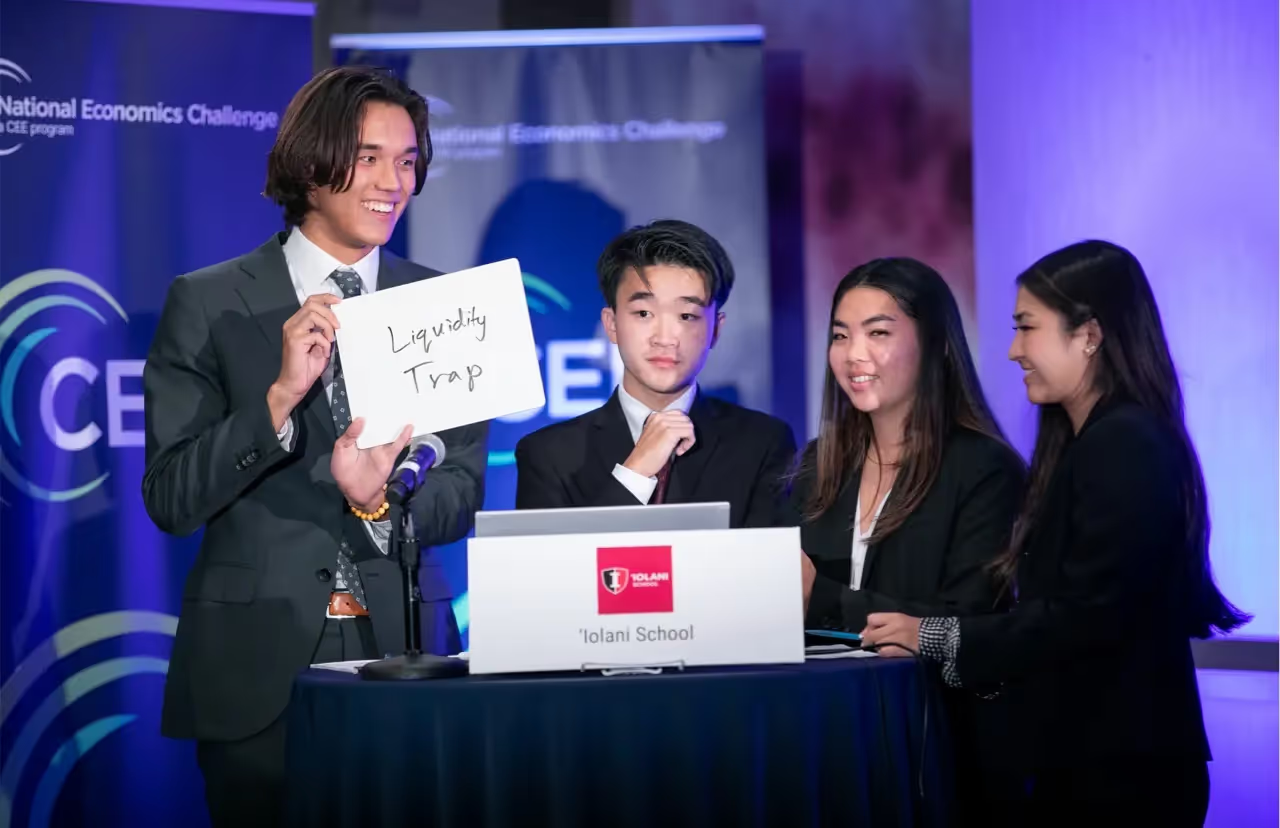
Organized by the Council for Economic Education, this is the only national economics competition exclusively for US high school students. Close to 10,000 students compete annually across two divisions: the Adam Smith Division for AP, IB, and honors students, and the David Ricardo Division for students with limited prior economics coursework. State-level winners advance to online semi-finals, with the top four teams receiving an all-expenses-paid trip to New York City for the national finals. Cash prizes up to $1,000 for first place. - American Mathematics Competitions
A series of nationally and internationally recognized math contests run by the Mathematical Association of America (MAA), serving as the primary pathway to the USA Mathematical Olympiad (USAMO) and the International Mathematical Olympiad (IMO). Over 300,000 students in 50 states and 30+ countries participate annually. High school students take the AMC 10 or AMC 12; top scorers qualify for the American Invitational Mathematics Examination (AIME). AMC 10A/12A: November 5, 2026; AMC 10B/12B: November 13, 2026. - Future City Competition
An engineering, design, and city planning competition organized by DiscoverE, open to both middle school (grades 6–8) and high school students. Teams of five work with a teacher-advisor and engineer mentor to design a city of the future addressing that year's theme — writing an essay, building a scale model, and presenting to judges. Regional winners advance to national finals in Washington, D.C. each February. Over 1,800 teams from 7 countries participated in the 2025–2026 cycle. Note: the competition was originally designed for middle school; high school participation varies by region. - NCF-Envirothon
An outdoor, team-based environmental science competition for high school students (grades 9–12) across the United States, Canada, China, and Singapore. Five-member teams are tested in Aquatic Ecology, Forestry, Soils and Land Use, Wildlife, and a current environmental issue topic. Over 25,000 students participate annually. State and regional winners advance to the annual North American competition; the 2026 event is held July 19–25 at Mississippi State University in Starkville, MS.
Navigating Your Path: Empowering Success Through Science
In essence, high school science competitions exemplify the potential of knowledge, inquiry, and perseverance. They bridge the gap between theoretical understanding and practical application, fostering a generation of inquisitive minds equipped to tackle real-world challenges. For both students and parents, these competitions offer a pathway to cultivate a lifelong love for learning, promoting growth that extends beyond classroom confines.
To further enrich your understanding of related opportunities, delve into our comprehensive discussions on research internships for high school students, summer research programs, and research opportunities. These articles offer valuable insights to enhance your educational journey and make the most of your high school years.
Science competitions give high school students a chance to apply classroom knowledge, develop research skills, and tackle real-world problems. From science fairs to specialized STEM competitions, the right opportunity can help you build both expertise and confidence.
At Indigo Research, students work one-on-one with expert mentors to develop original research and prepare their work for journals, conferences, and science competitions. Discover how Indigo Research can help you turn your scientific interests into meaningful academic work.